
Home care workers (HCWs) are frontline healthcare workers who provide critical rehabilitative and long-term care services within patients’ own homes. During the COVID-19 pandemic, many HCWs described feeling underappreciated by the public and other parts of the healthcare system.
HCWs in NYC are minimally paid, with varying degrees of training, and tend to be women from ethnic minority and low-income backgrounds. As they work directly in patients’ homes and not in a traditional office or clinic setting, they have little access to resources and support. This also prevents HCWs from being able to talk to each other to share experiences, knowledge, create norms around good practice, and reduces opportunities to mobilize around common issues.
We worked with HCWs and 1199SEIU, the local healthcare worker union, to design technology to support HCWs.
Exploring needs and possiblities using scenario-based design techniques.
Recording of a scenario used to explore potential roles of technology in HCWs' work and life.
We used scenario-based design to imagine how different types of technology could fit into HCWs' work routines and address different types of needs. HCWs were already familiar with technology as a tool to monitor and organize their work, such as clocking into a shift or ensuring that tasks were completed. However, in our design process, we created futuristic and slightly fantastical scenarios to encourage participants think speculatively about new possibilities. We explored the types of support HCWs needed and imagined how technology could be a tool for supporting these needs, rather than just monitoring their work.
Reaching isolated workers with peer-led video conferencing support groups.
Based on the results of the scenario-based design, we developed a virtual, peer-led support group program. We recruited and trained HHCWs to be facilitators and observed support groups in action over the course of multiple months. We conducted interviews of both support group participants and faciliators to understand the value of virtual peer-led support, even when conducted through a video conferencing medium. We conducted thematic analysis of observational notes and interview transcripts to identify challenges that HCWs faced using video conferencing, both from a facilitation and participation perspective.
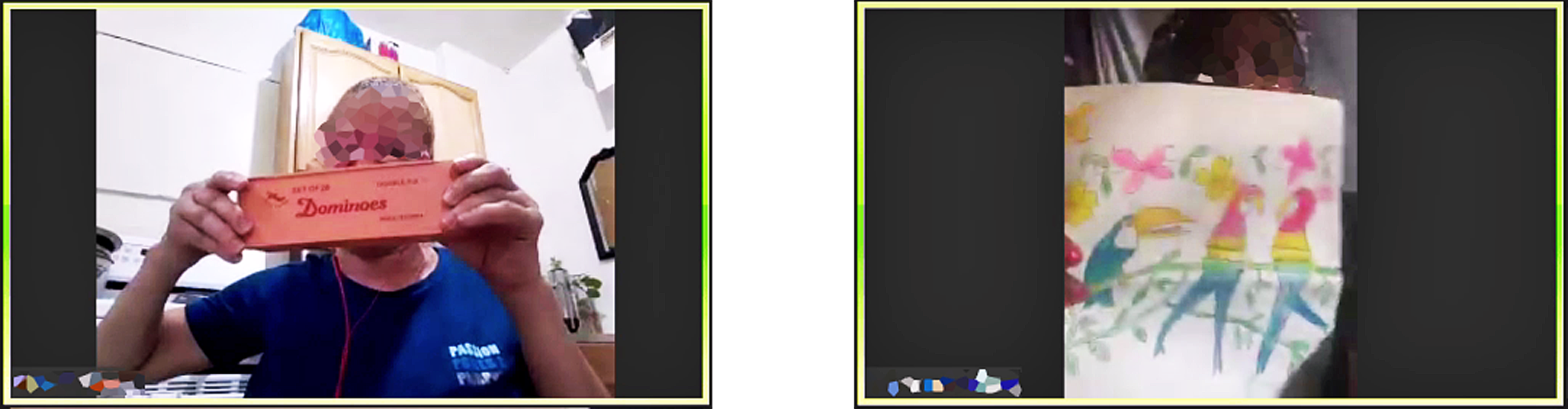
Participants used the video to share and show objects to the group to tell stories about their work.
We found that virtual, peer-led support groups enabled HHCWs to provide and share various types of support through video conferencing. HHCWs told stories to vent emotionally about challenging experiences, validate and mirror each others’ experiences, highlight expertise and provide advice, and create awareness of common problems. Video conferencing allowed HHCWs to participate between busy cases or on lunch breaks, involve their friends listening in the background, and use props in their stories. Similar support groups could be used to reach simiarly distributed and isolated populations.
- In partnership with the 1199SEIU Training and Education Fund (TEF).


